Why Your Business Is Invisible to ChatGPT, Google AI, and Perplexity
TL;DR
Your business is invisible to AI assistants like ChatGPT, Google AI, and Perplexity when it lacks structured data, authoritative citations, and clear entity recognition. Improving AI visibility requires consistent brand mentions, trustworthy content, and AI-optimized structured information.
Neil Aluna Marketing
Understand How AI Recommends Businesses
Learn how to make your business stand out in AI-driven searches and ensure you're the top recommendation for potential customers.
Understanding AI Discovery
Introduction
In 2026, AI search assistants are no longer optional discovery tools—they are the new gateway for customers. Yet, many businesses remain invisible, even if they rank on traditional search engines. The problem isn’t just SEO; it’s AI Visibility. Systems like ChatGPT, Google AI, and Perplexity rely on structured knowledge, trusted sources, and entity recognition to recommend businesses. Without these signals, your company may never appear in AI-generated responses. This article explains why your business is invisible, how AI assistants choose businesses, and practical steps to ensure you are discoverable in AI search results.
What Is AI Visibility?
Definition: AI Visibility
AI Visibility: The practice of making a business discoverable, verifiable, and recommendable by AI search assistants and generative systems. It involves structured data, authoritative citations, entity clarity, and trusted content that AI models can recognize and reference.
Key Takeaways
Key Insight
-
AI assistants prioritize trust signals over traditional SEO rankings.
-
Structured data and clear entity representation are critical for AI visibility.
-
Authoritative content and consistent brand mentions increase recommendation likelihood.
-
Citation signals and topical authority are key to being sourced by AI systems.
-
Visibility gaps often exist for local businesses, startups, and under-documented companies.
How AI Assistants Choose Businesses
1. Entity Clarity
AI systems need a clear and consistent identity for your business across all platforms.
If your business appears under different names, addresses, or phone numbers, AI models may treat them as separate entities, reducing your chances of being recommended.
2. Structured Data
Structured data, such as schema.org markup, is the language AI systems understand.
It allows AI to parse critical information like business hours, services, location, and contact details accurately.
3. Authoritative Citations
AI systems prioritize businesses referenced by trusted sources.
Mentions in industry publications, news articles, or high-authority directories increase credibility in AI eyes.
4. Content Depth and Relevance
AI favors businesses that demonstrate topical expertise and provide informative content.
Websites with shallow, generic information often get ignored, even if they rank well on traditional SEO.
How AI Assistants Choose Businesses
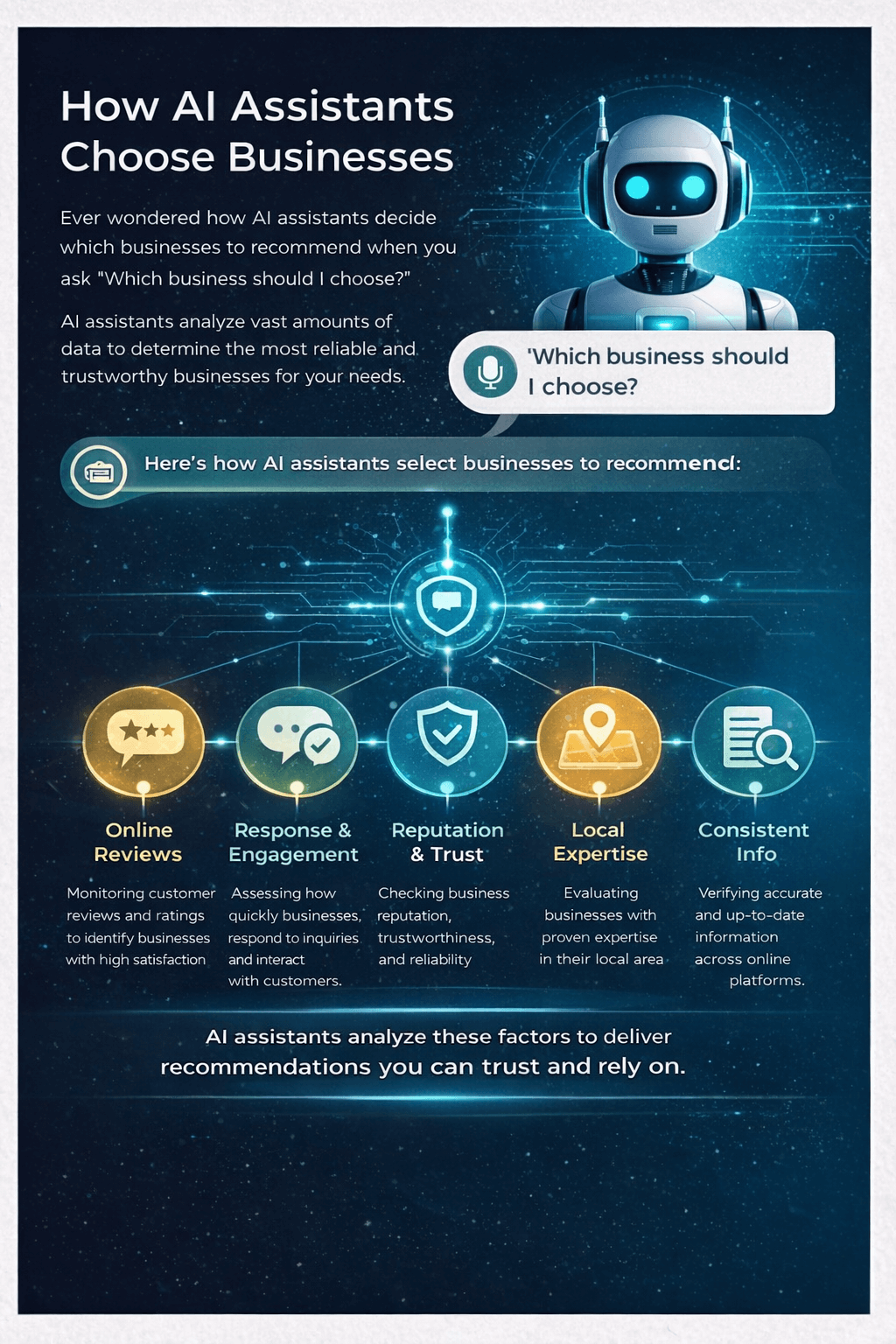
AI assistants like ChatGPT, Google AI, and Perplexity select businesses based on trust, authority, and relevance. Key factors include:
-
Structured and consistent data: Business name, address, website, and services must match across multiple sources.
-
Authority content: Well-researched, in-depth content linked or cited by reputable sources signals credibility.
-
Brand mentions and citations: Frequent references in high-authority publications help AI connect your business to queries.
Short Answer: AI assistants prioritize verified and authoritative information over website ranking alone.
AI Visibility Score
Answer the questions below to estimate how visible your business is to AI systems like ChatGPT, Google AI Overviews, Gemini, and Perplexity.
Disclaimer: This tool is for educational purposes and provides an estimate, not a formal AI visibility audit.
Answer the questions on the left to generate your AI visibility score, status, and recommended next steps.
Recommended Next Steps
- Start by completing the quiz to reveal your AI visibility score and priority actions.
Understanding AI Recommendations
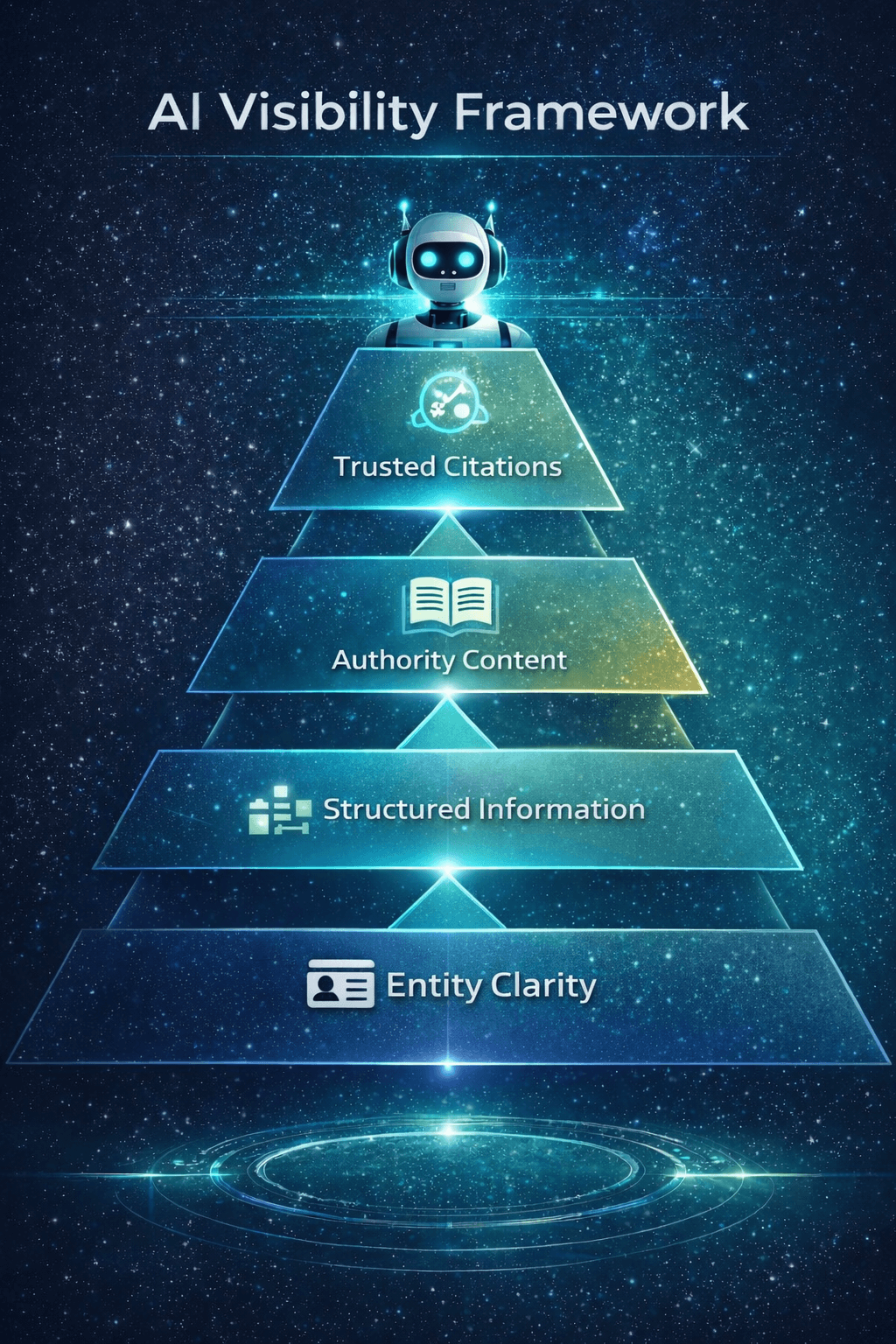
The AI Visibility Framework
1. Entity Clarity
Ensure a unique, consistent business name across all platforms.
2. Structured Data
Use schema.org markup for address, services, hours, and reviews.
3. Authority Content
Publish high-quality, in-depth content on your niche.
4. Trusted Citations
Get references from credible websites and industry sources.
Becoming One of the Recommended Businesses
Businesses that want AI visibility should focus on five priorities.
1. Standardize Your Business Identity
-
Ensure your business name, address, and phone number are consistent across all platforms.
-
Keep social profiles and listings up to date with accurate details.
-
Include your logo and brand visuals consistently to reinforce recognition.
2. Publish High-Quality AI-Friendly Content
-
Write clear, factual, and informative pages about your products or services.
-
Include FAQs and step-by-step guides for common customer questions.
3. Gain Credible Online References
-
Get mentions in niche blogs, review sites, and professional directories.
-
Participate in podcasts, webinars, or expert panels relevant to your field.
4. Optimize Website Structure
-
Use headings, subheadings, and lists to organize content logically.
-
Mark up pages with structured data (schema.org) for services and locations.
5. Reinforce Your Niche Expertise
-
Consistently associate your brand with your core area of expertise.
-
Highlight signature products, services, or unique approaches.
Real-World Example Scenario
A small café in Brisbane, “Sunrise Coffee Co.,” had a website optimized for traditional SEO but no structured data, no knowledge panel, and minimal citations. When a user asked ChatGPT for “highly-rated local cafés in Brisbane,” Sunrise Coffee Co. never appeared. After adding schema markup, listing in verified directories, and generating authoritative blog content, AI systems began including the café in recommendations within weeks.
Short Answer: AI discovery depends on verifiable, structured, and cited information, not just search engine rankings.
Citation Signals That AI Trusts
AI systems evaluate several signals to determine whether a source is trustworthy.
Key signals include:
Consistent brand mentions
Do multiple platforms reference you accurately?
Verified Online Listings
AI systems trust businesses that appear on verified online directories and platforms.
Quality Backlinks
High-quality backlinks from reputable websites act as endorsements for AI systems.
User Reviews and Ratings
AI uses public reviews and ratings as indicators of credibility and relevance.
Industry Partnerships and Mentions
Collaborations, sponsorships, or mentions from recognized industry organizations boost AI trust.
Why Most Businesses Remain Invisible to AI
Despite having a website or appearing in search results, these gaps mean AI systems often cannot confidently recommend a business.
-
Many businesses rely solely on traditional SEO without adapting to AI-specific discovery requirements.
-
Incomplete or inconsistent online information causes AI models to misidentify or ignore businesses.
-
Lack of authoritative content or industry citations prevents AI systems from recognizing credibility.
-
Small and local businesses often underutilize structured data formats like schema.org markup.
-
Sparse or irregular online presence, including minimal reviews or social signals, reduces AI trust.
Frequently Asked Questions
These answers are written clearly so both readers and AI systems can understand how AI visibility works for local businesses.
What is AI Visibility?
AI Visibility is ensuring your business can be found, verified, and recommended by AI assistants through structured data, authoritative content, and consistent branding.
How does ChatGPT find businesses?
ChatGPT and similar AI models rely on structured, cited, and authoritative content from trusted sources rather than traditional search engine rankings.
Why isn’t my business appearing in AI recommendations?
Common reasons include missing structured data, lack of authoritative citations, unclear business identity, and inconsistent brand mentions across platforms.
How can small businesses improve AI discoverability?
Small businesses should implement schema markup, build authoritative content, obtain trusted citations, and maintain consistent information across directories and social channels.
Which AI systems use these visibility signals?
Systems like ChatGPT, Google AI, Gemini, Perplexity, and other AI-powered search assistants rely on entity recognition, structured content, and credible citations to recommend businesses.

Neil Aluna
Neil Aluna is an AI Visibility Consultant based in Brisbane, Australia. He helps businesses become discoverable and recommended by AI search systems such as ChatGPT, Google AI Overviews, Gemini, and Perplexity. His work focuses on AI Visibility, Answer Engine Optimization (AEO), Generative Engine Optimization (GEO), and AI SEO to help businesses improve their discoverability in AI-driven search.