Lesson 1B
How AI Actually Works
Understanding How AI Thinks: LLMs, Tokens, Meaning — and Why Unclear Business Information Confuses AI
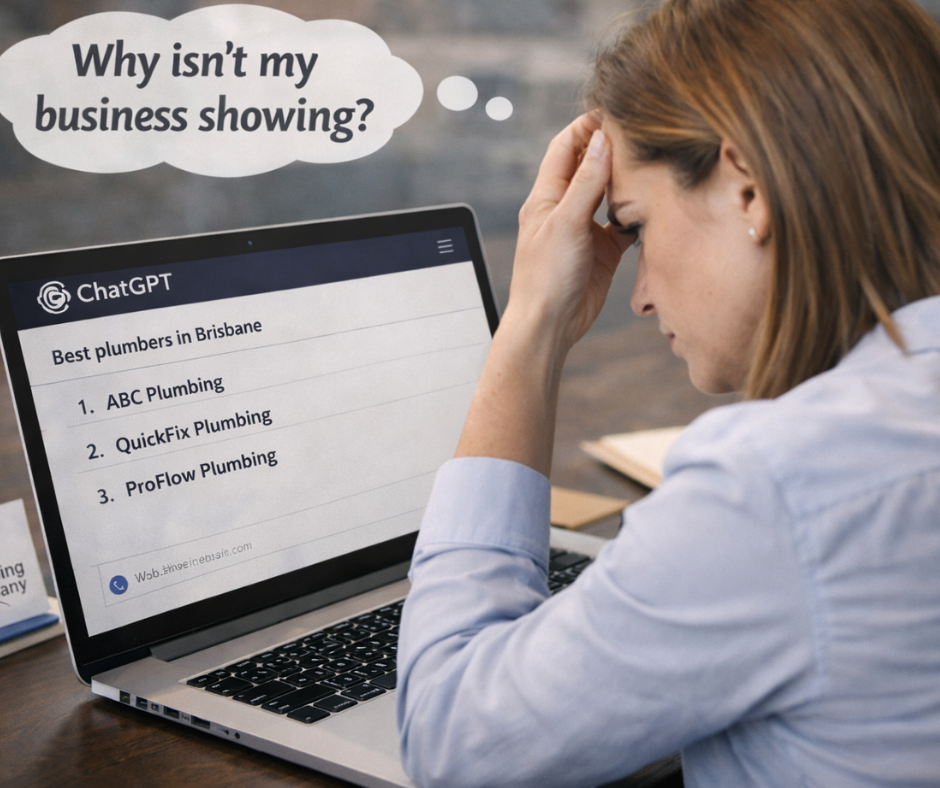
By the end of this lesson, you’ll understand how AI “reads” your business, why vague language makes you invisible, and what you must do so AI can confidently understand and recommend you.
Understanding AI Search
What Is an LLM (Large Language Model)?
An LLM is the “brain” behind tools like ChatGPT and Google AI Overviews.
It does one core job:
Predict the most likely next words based on patterns it has learned.
It does not:
-
browse the internet like a human
-
understand your intentions
-
automatically know your business exists
Important mindset shift
AI does not recognise businesses —
It infers them from data.
If your data is unclear, AI does not guess.
It skips.
Example
You ask AI:
“Best electrician in Logan”
AI does not think:
“Let me search for electricians.”
It thinks:
“Which businesses can I confidently explain, verify, and safely recommend?”
If it can’t do that, it gives generic advice or names competitors it trusts more.
What to do (implementation)
-
Write one plain-English sentence that explains:
-
who you are
-
what you do
-
where you do it
-
-
Place it:
-
near the top of your homepage
-
on your main service pages
-
Example
“We are licensed electricians servicing Logan, Beenleigh, and surrounding suburbs, specialising in emergency repairs and residential electrical work.”
How AI “Thinks” (Prediction, Not Truth)
Simple explanation
AI does not decide what is true.
It decides what is most likely based on patterns.
If information is:
-
vague
-
inconsistent
-
incomplete
AI cannot reach confidence.
Key term explained
Hallucination
When AI sounds confident but is guessing.
To avoid this, AI prefers to not recommend businesses at all unless it’s sure.
Example
Website says:
“We service clients across South East Queensland.”
AI cannot confidently answer:
“Do they service Logan?”
So you’re excluded.
Understanding AI and Language
Tokens: Why AI Needs Simple, Clear Wording
Simple explanation
AI reads text in tokens — small chunks of words.
Marketing language often:
-
sounds good to humans
-
means nothing to AI
Example
Bad for AI:
“Delivering premium electrical solutions with excellence.”
Good for AI:
“We provide residential and emergency electrical services in Logan.”
What to do
Reduce clever wording
-
-
Use direct service language:
-
electrician
-
plumber
-
dentist
-
-
Use customer-style phrases:
-
“emergency”
-
“near me”
-
“open today”
-
-
Artificial Intelligence processes information using tokens, which are small segments of text. This means that while humans might appreciate elaborate language, AI requires straightforward and precise wording to understand and process information effectively.
Marketing language that appeals to human emotions and creativity often fails to communicate effectively with AI systems.
For instance, phrases like ‘providing unparalleled service excellence’ may sound impressive but offer little clarity to AI.
To ensure AI systems can accurately interpret and recommend your business, use clear and direct language.
Focus on specific services and locations, such as ’24/7 emergency plumbing services in Brisbane,’ to enhance AI comprehension and improve your business’s visibility in AI-driven searches.
Context Windows: Why Important Info Must Appear Early
Simple explanation
AI often reads only part of a page, not everything.
If your key info is buried:
-
AI may never see it
-
or may extract the wrong meaning
Example
If “teeth whitening” is mentioned once, halfway down the page, AI may assume you don’t really offer it.
What to do
-
Put your core services + locations in:
-
first screen of the page
-
-
Add a short “Quick Summary” section:
-
Services offered
-
Areas serviced
-
Years in business
-
In the digital age, where AI plays a pivotal role in interpreting and ranking online content, it’s crucial to strategically place key information early on your webpage.
This ensures that AI systems can easily identify and process the most important aspects of your business, such as core services and locations.
By doing so, you enhance the likelihood of being recommended by AI, which often prioritizes clarity and relevance.
Make sure your essential details are visible right from the start to avoid being overlooked by AI algorithms.
How AI Interprets This Question
See how AI assistants interpret real customer searches — and why most businesses are skipped.
AI Intent Breakdown
Why AI May Skip You
* Demo tool only. Results are estimates based on common AI trust signals.
Embeddings: How AI Matches Meaning (Not Keywords)
Simple explanation
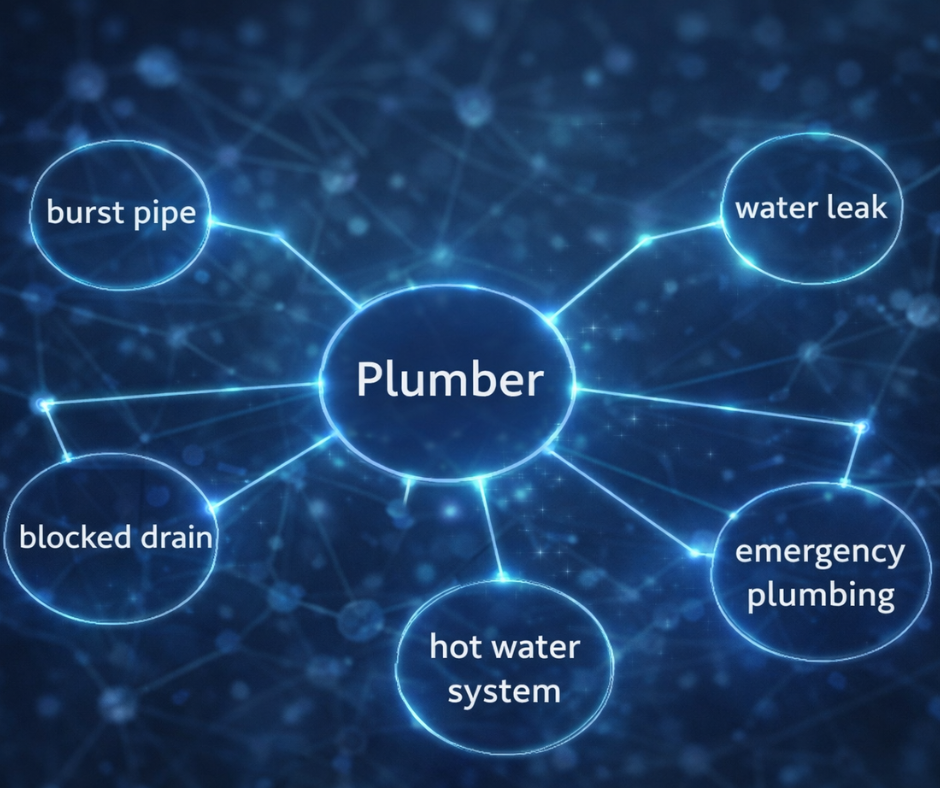
AI converts text into meaning-based fingerprints so it can match similar ideas.
This means:
-
“burst pipe”
-
“water leak”
-
“emergency plumbing”
…can all match if your wording is clear.
Example
If your site only says:
“Hydraulic system maintenance”
AI may not connect you to:
“Fix leaking tap near me”
What to do
-
Use natural language variations
-
Add FAQs using customer language:
-
“Do you fix burst pipes?”
-
“Can you help today?”
-
-
Avoid industry-only jargon without explanation
Artificial Intelligence transforms text into complex meaning-based patterns, allowing it to recognize and connect similar concepts.
This means that phrases like ‘burst pipe,’ ‘water leak,’ and ’emergency plumbing’ can all be linked if your language is clear and varied.
For example, if your website only mentions ‘Hydraulic system maintenance,’ AI might not associate it with ‘Fix leaking tap near me.’
To enhance AI understanding, use diverse, natural language and incorporate FAQs that reflect real customer inquiries, such as ‘Do you repair burst pipes?’ or ‘Can you assist today?’
Avoid using industry-specific jargon without providing explanations to ensure AI can accurately interpret your content.
Understanding AI Memory vs. Live Data
Simple explanation
AI may rely on:
-
past training data (old)
-
live data sources it trusts
-
structured business databases
If your business is:
-
inconsistent
-
missing details
-
unclear
AI does not “fill in the gaps.”
Example
Your website says one phone number
Google Business Profile shows another
Directory listings show different names (like BizzlinkAI)
AI sees uncertainty → no recommendation.
What to do
- Make sure NAP (Name, Address, Phone) matches everywhere
- Use the same business name format
- Check Google Business Profile, website, and key listings
Step 1
Step 1: Recognize the Difference
AI systems rely on both historical data and real-time information to make informed decisions. Understanding this balance is crucial for optimizing AI interactions.
Step 2
Step 2: Identify Inconsistencies
Inconsistent business information can confuse AI, leading to unreliable recommendations. Ensure that your business details are uniform across all platforms.
Step 3
Step 3: Enhance Data Consistency
To improve AI accuracy, maintain consistent NAP (Name, Address, Phone) details and ensure your business name is formatted uniformly across all listings.
Why AI Prefers Clarity Over Guesswork
Why AI Skips Businesses Instead of Guessing
Simple explanation
AI avoids recommending businesses unless it is confident.
This is why it often recommends:
-
only 3–5 businesses
-
not the whole market
Example
Two dentists in the same suburb:
-
Dentist A: clear services, reviews, credentials
-
Dentist B: vague services, generic wording
AI chooses A — not because they’re “better,” but because they’re clearer.
What to do
-
Add proof:
-
reviews
-
licenses
-
experience
-
-
Add an “About the Owner / Practitioner” section
-
Use real photos and real name.
Artificial Intelligence, when tasked with recommending businesses, relies heavily on clarity and precision.
It doesn’t gamble with guesses; instead, it selects businesses that present clear and verifiable information.
This approach ensures that AI only suggests businesses it can confidently stand behind, often narrowing down to a select few rather than an entire market.
For example, when comparing two dentists in the same area, AI might choose the one with detailed service descriptions, genuine reviews, and visible credentials over another with vague and generic information.
This choice isn’t about quality but about clarity.
To ensure your business stands out, provide solid proof through reviews, licenses, and experience.
Additionally, including an ‘About the Owner’ section with real photos and names can significantly enhance AI’s confidence in recommending your business.

🧠 AI Understanding Simulator
See how AI may interpret your business description — and why vague wording gets skipped.
1) Paste your business description
Tip: paste your homepage opening paragraph or your “About” summary.
🔴 How AI may interpret this
—- Business type: —
- Primary service: —
- Service location: —
- Confidence level: —
- Recommendation likelihood: —
Run an analysis to see what AI can (and can’t) confidently infer.
🟢 What AI needs instead
High confidence- Business type: electrician
- Primary services: emergency repairs, residential electrical
- Service location: Logan, Beenleigh, Browns Plains
- Confidence level: HIGH
- Recommendation likelihood: ✅ Eligible
Fixes that increase AI confidence
- Add your exact service type (e.g., “electrician”, “dentist”, “plumber”).
- List 2–5 specific services you actually provide.
- State the suburbs/areas you service (not “South East QLD”).
2) Rewrite using this template
Make your business easy for AI to understand: Who you are + what you do + where you do it.
We are a [service type] based in [location].
We provide [core services].
We service [specific suburbs/areas].
Before
—
After
—
What improved
- —
Lesson 1B – Key Takeaways
-
AI predicts, it doesn’t browse
-
Clarity beats cleverness
-
Vague language causes invisibility
-
AI avoids risk — it doesn’t guess
-
Being “online” ≠ being understood
Next lesson:
We move from how AI thinks to how AI sees your business — as an entity.
🧠 Want help applying this to your business?
Book a free AI Visibility Review Session with Neil to clarify how AI likely understands your services and location. Educational only — no sales pitch.
👉 Book Free Review SessionThis lesson is educational. Results vary by industry, location, and data quality.