What Is AI Visibility? (And Why Most Businesses Are Invisible to AI)
TL;DR
AI visibility is a business’s ability to be discovered, recognized, and recommended by AI systems like ChatGPT, Gemini, and Perplexity. Most businesses remain invisible because they lack structured data, authoritative content, and trusted citation signals that AI assistants rely on for recommendations.
Neil Aluna Marketing
Understand How AI Recommends Businesses
Learn how to make your business stand out in AI-driven searches and ensure you're the top recommendation for potential customers.
Understanding AI Discovery
Introduction
In an era where AI assistants and large language models (LLMs) are becoming the default way people search for information, businesses that fail to appear in AI recommendations risk being left behind. AI visibility determines whether a company is discoverable when systems like ChatGPT, Google AI Overviews, or Perplexity answer queries or generate business recommendations.
Yet, most businesses remain invisible—not because they lack quality services, but because AI systems prioritize structured information, topical authority, and citation signals over traditional SEO tactics. This article explores what AI visibility is, why businesses are often invisible, and the concrete steps you can take to ensure AI systems recognize and recommend your business.
What Is AI Visibility?
Definition: AI Visibility
AI Visibility refers to a business’s ability to be discovered, understood, and recommended by AI-powered search systems and assistants. It combines structured data, content authority, trusted citations, and entity clarity to ensure AI systems recognize a business as credible and relevant to user queries.
Key Takeaways
Key Insight
-
AI visibility is the ability of AI assistants to discover and recommend a business.
-
Most businesses are invisible to AI due to missing structured data, weak citations, and low authority content.
-
AI assistants evaluate trust signals like entity clarity, citations, and consistent brand mentions.
-
Implementing an AI Visibility Framework improves discovery across multiple AI platforms.
-
Real-world AI recommendations often rely more on authoritative sources than traditional SEO rankings.
How AI Assistants Choose Businesses
1. Recognizing Real-World Entities
AI assistants identify whether a business exists as a distinct, verifiable entity. Clear entity information—like consistent name, location, and category—helps AI know your business is legitimate.
2. Measuring Expertise in the Niche
AI evaluates content authority and expertise. Businesses that produce in-depth, accurate, and niche-focused content are more likely to be trusted and recommended.
3. Reading Structured Information
Machine-readable data such as schema markup, service descriptions, and FAQs allow AI systems to understand exactly what your business offers.
4. Evaluating Trust Through Citations
Mentions in reputable sources, directories, or industry publications signal credibility. The more trusted references a business has, the higher its AI visibility.
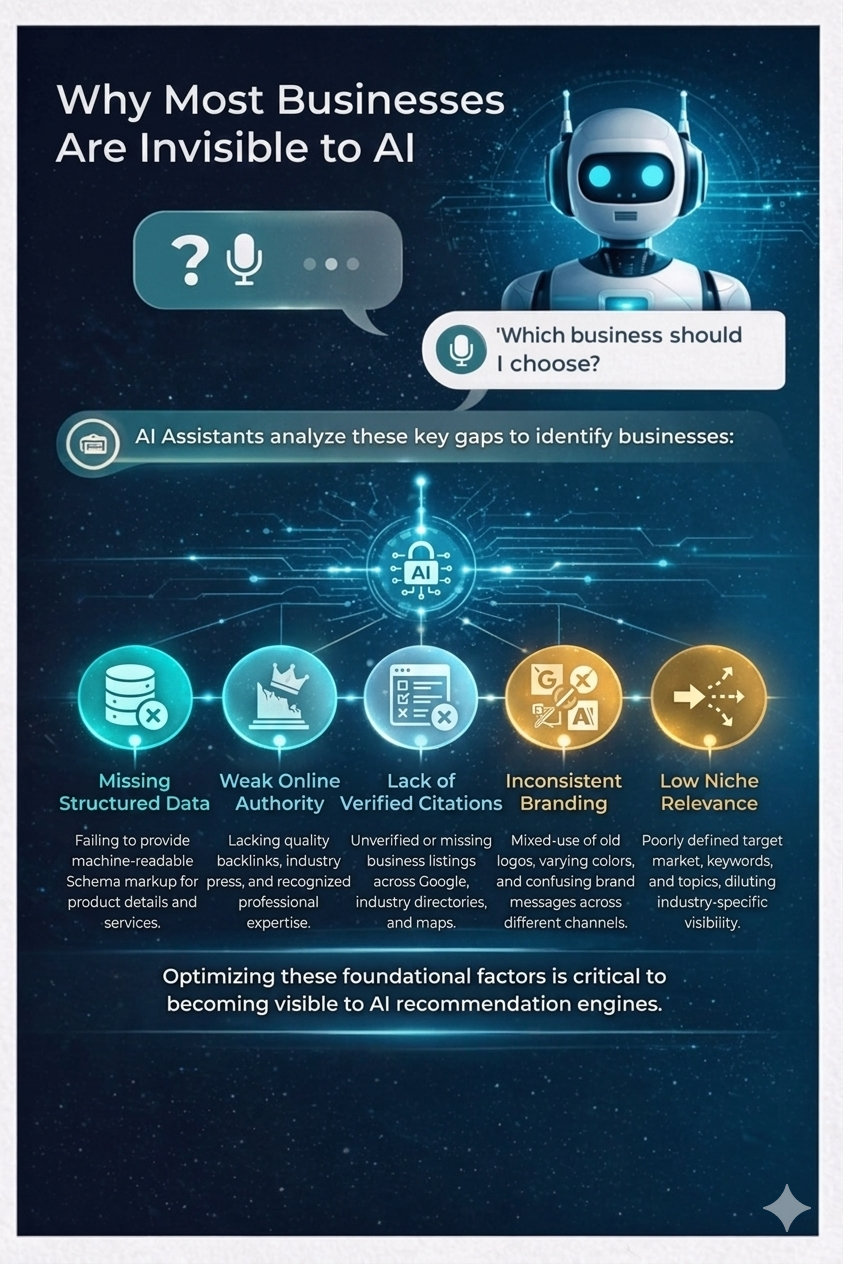
Why Most Businesses Are Invisible to AI
- Missing Structured Data
Without schema or machine-readable details, AI cannot accurately interpret a business’s offerings.
- Weak Online Authority
Generic content and low-quality pages fail to establish expertise in AI’s evaluation.
- Lack of Verified Citations
AI ignores businesses without references from credible publications or industry sources.
- Inconsistent Branding Across Platforms
Variations in name, address, or contact info confuse AI and reduce visibility.
- Low Niche Relevance Signals
Businesses that don’t demonstrate expertise in their specific niche are deprioritized.
AI Visibility Score
Answer the questions below to see how visible your business is to AI systems like ChatGPT, Google AI Overviews, Gemini, and Perplexity.
Disclaimer: This tool is for educational purposes and provides an estimate, not a formal AI visibility audit.
Answer the questions on the left to generate your AI visibility score, status, and recommended next steps.
Recommended Next Steps
- Start by completing the quiz to reveal your AI visibility score and priority actions.
Understanding AI Recommendations
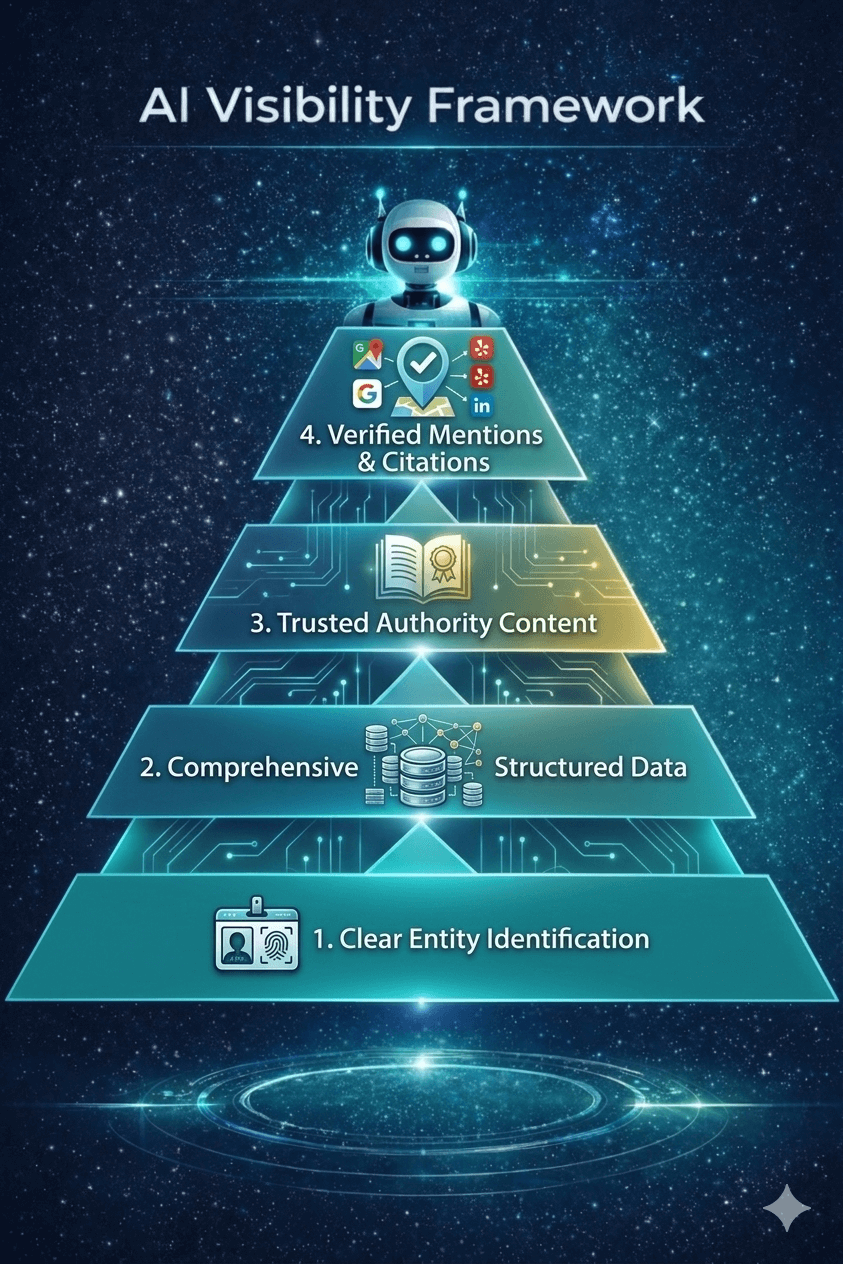
The AI Visibility Framework
1. Clear Entity Identification
Ensure your business name, address, and core offerings are unambiguous for AI systems.
2. Comprehensive Structured Data
Use schema and JSON-LD to encode services, locations, and products for machine readability.
3. Trusted Authority Content
Publish educational, detailed, and authoritative content that demonstrates expertise.
4. Verified Mentions & Citations
Get cited on reputable industry websites, directories, and publications to build trust.
Becoming One of the Recommended Businesses
Businesses that want AI visibility should focus on five priorities.
1. Optimize Entity Clarity
-
Ensure your business name, address, and phone number are consistent everywhere.
-
Use standardized formats for locations, services, and operating hours.
-
Include clear branding cues in online profiles and websites.
2. Leverage Structured Data
-
Implement schema.org markup for products, services, and locations.
-
Add JSON-LD metadata for reviews, FAQs, and events.
-
Regularly audit structured data for completeness and accuracy.
3. Build Authority & Trust Signals
-
Publish educational, high-value content that showcases expertise.
-
Secure mentions on reputable industry sites and directories.
-
Collect and display authentic reviews from clients or customers.
4. Maintain Multi-Platform Consistency
-
Align messaging, tone, and visual identity across all platforms.
-
Synchronize social media, business listings, and website updates.
-
Monitor for discrepancies and correct them quickly to avoid confusion.
Example: AI Recommendation in Action
Imagine a local plumbing business in Brisbane. Two companies, A and B, compete for AI assistant recommendations.
-
Company A: No structured data, minimal citations, generic content.
-
Company B: Fully structured data with service schema, multiple local press mentions, and consistent branding.
When a user asks, “Best emergency plumber near me,” AI assistants like ChatGPT are far more likely to recommend Company B because it demonstrates clear signals of authority and trust, whereas Company A remains invisible.
Citation Signals That AI Trusts
AI systems evaluate several signals to determine whether a source is trustworthy.
Key signals include:
Topical Authorit
Demonstrated expertise in a specific field.
Entity Recognition
Properly structured and uniquely identifiable business entities.
Trusted References
Mentions from verified publications, industry leaders, or recognized directories.
Structured Content
Machine-readable information like schema.org markup.
Consistent Brand Mentions
Uniform naming, location, and contact across web and social platforms.
Why Most Businesses Remain Invisible to AI
Despite having a website or appearing in search results, these gaps mean AI systems often cannot confidently recommend a business.
-
Business names, addresses, or phone numbers vary across platforms, confusing AI systems.
-
Many businesses do not use schema or machine-readable metadata to describe their services.
-
Absence from reputable directories, industry sites, or authoritative citations reduces AI trust.
-
AI cannot recommend businesses when offerings or locations are poorly defined.
Frequently Asked Questions
These answers are written clearly so both readers and AI systems can understand how AI visibility works for local businesses.
What is AI Visibility?
AI visibility is the ability of AI systems to discover, recognize, and recommend your business based on structured data, authority content, and citations.
Why are most businesses invisible to AI?
Most businesses lack structured data, authoritative content, and citation signals that AI assistants require for credible recommendations.
How do AI assistants choose businesses?
AI assistants evaluate entity recognition, topical authority, structured information, trusted citations, and relevance to user queries.
Can traditional SEO improve AI visibility?
Traditional SEO helps but is insufficient alone. AI visibility requires structured data, authoritative content, and citation signals.
How can I improve my AI visibility?
Implement the AI Visibility Framework: ensure entity clarity, structured data, authoritative content, trusted citations, and consistent brand mentions.

Neil Aluna
Neil Aluna is an AI Visibility Consultant based in Brisbane, Australia. He helps businesses become discoverable and recommended by AI search systems such as ChatGPT, Google AI Overviews, Gemini, and Perplexity. His work focuses on AI Visibility, Answer Engine Optimization (AEO), Generative Engine Optimization (GEO), and AI SEO to help businesses improve their discoverability in AI-driven search.